Tokens Not Included
I made this realtime viewer for my Claude Code agents, inspired by Oxygen Not Included. I’ve been experimenting with parsing Claude Code’s session logs and finding ways to see multiple parallel sessions work in real time, because I needed a way to see what all my agents are doing at once. Last week I wrote about the sunflower view. This is Tokens Not Included, or TNI, which I’ve been using for around four weeks now.
I haven’t open sourced it yet, so this is a sneak preview.
Why a colony
I wanted to make watching my agents work fun and nice to look at, and I’ve always been a fan of ONI, although I haven’t played it in a while.
Most of the agent viewers out there use office layouts, where agents sit at a desk in front of a computer. Pixel Agents is the biggest of them, with over 10,000 GitHub stars. I didn’t like that. What’s the point? Everybody, even us, is already looking at monitors.
I wanted an Oxygen Not Included colony, with multiple floors and machines for the work they’re doing. I wanted the agents to actually run around the colony and operate the machinery.
The sunflower view shows a lot more information, and I find it valuable when I want the detail. But I tend to keep the TNI tab open more often because I like looking at it. I like seeing the agents running around, doing stuff, talking to each other, etc. It lets me keep an eye on what they’re doing, and it’s fun. It feels like I’m working, doing my job, but I’m also kind of playing ONI.
Reading the colony
In Tokens Not Included, floors are repositories. Code files, including scripts, sources and tests, are machines; notes, docs and other non-code files are bookshelves. In this close-up of the Command Bridge repo floor, the machines are labeled cli.py, test_watch.py and server.py, and one of the agents is thinking with a hand on its chin.
Commands are stations, like a phone switchboard for herdr, a record press for git, or a rocket for docker. Commands that don’t belong to a repo get their own floor of stations. On the commands floor below, an agent hammers at the pytest machine next to the Command Bridge gauges station. I can see the command it’s running by where it’s working.
The characters’ life bars are their context windows, and the station bars show how much each agent has interacted with them.
I love how the agents sleep in their beds when they’re not running, go get some coffee in the cafeteria when idle, or talk to each other when coordinating. Here an idle agent drinks coffee while another climbs the ladder. It’s really fun to watch my agents do my work this way.
Making the art
I made this with Claude. I’ve been working on it over nights and weekends for over a month, iterating on the feedback I collected while watching it. I told Claude to prompt Codex to generate the art sprites, then Claude cut them, cleaned them and upscaled them. It was amazing to watch it iterate on its own to get the art looking good, and I watched it all through TNI too.
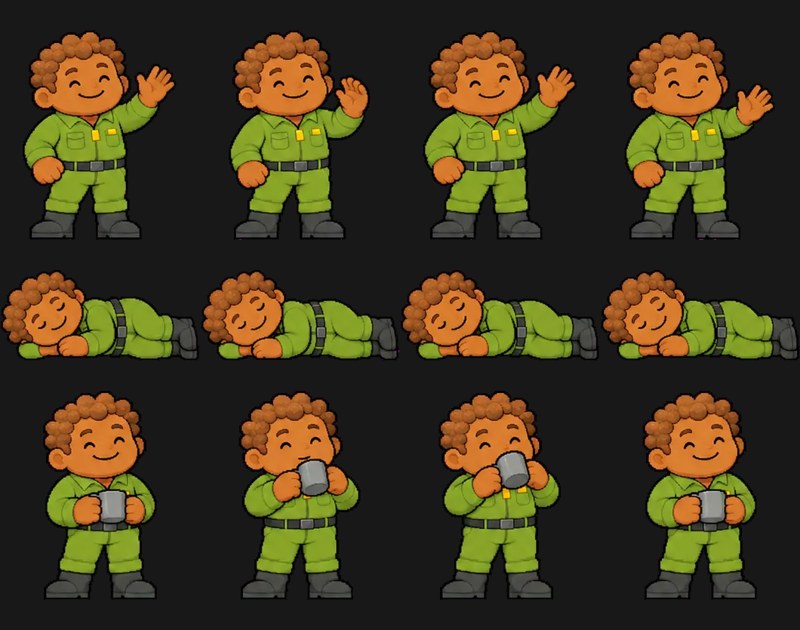
For example, Claude suggested upscaling the art because Codex returns about 1.5 megapixels per image, roughly 300 pixels per pose on a 16-pose sheet. It also cleaned up the magenta backgrounds around the sprites. I could see weird magenta edges around the agents, and some was still showing in one agent’s glasses as we worked through the cleanup.
What comes next
Next I’m adding overlays like in ONI. In Oxygen Not Included you switch on a layer and see how air moves, where liquids flow, how the electricity runs through the colony’s machines. I want the same for my agents: one kind of information on top of the world at a time.
A token heat map shows where the work is happening: heat pools around each agent by how many tokens it’s using a minute, and streams toward the machines its calls land on. A spend overlay treats money like power. Each machine plugs into a socket that shows what it’s drawing, in dollars per hour. Hovering a socket shows which agents drew from it, how many calls and what each cost.
A git overlay draws each repo as a timeline, with bars for lines added and lines removed, per commit, scrolling with time. And on the machines themselves, a small clock shows how long a script has been running for.
My goal is to pack as much information about my agents’ behavior as possible. Suggestions are welcome.
Agents in other worlds
Age of Agents already has settlers walking to workshops according to the tool they’re using. claude-village maps tools to zones in a Minecraft-style village. People are putting agents in offices, strategy maps, villages, and now an ONI-style colony.
All this tells me that folks want to see their agents work, and want it to be something they enjoy watching. Someone even asked for Terraria and This War of Mine skins. We’re going to be using more agents, and we want to watch them work in these worlds that we love.
Maybe working with agents starts to look more like playing a game. I don’t know where this goes, but we hand our agents real jobs, and we want to keep an eye on them while they work, in a world we actually enjoy looking at.
Tokens Not Included isn’t affiliated with Klei, who make Oxygen Not Included.
The TNI repo is up with a preview, and the sources and install are coming soon. Keep an eye out for the next post.