What Sets You Apart
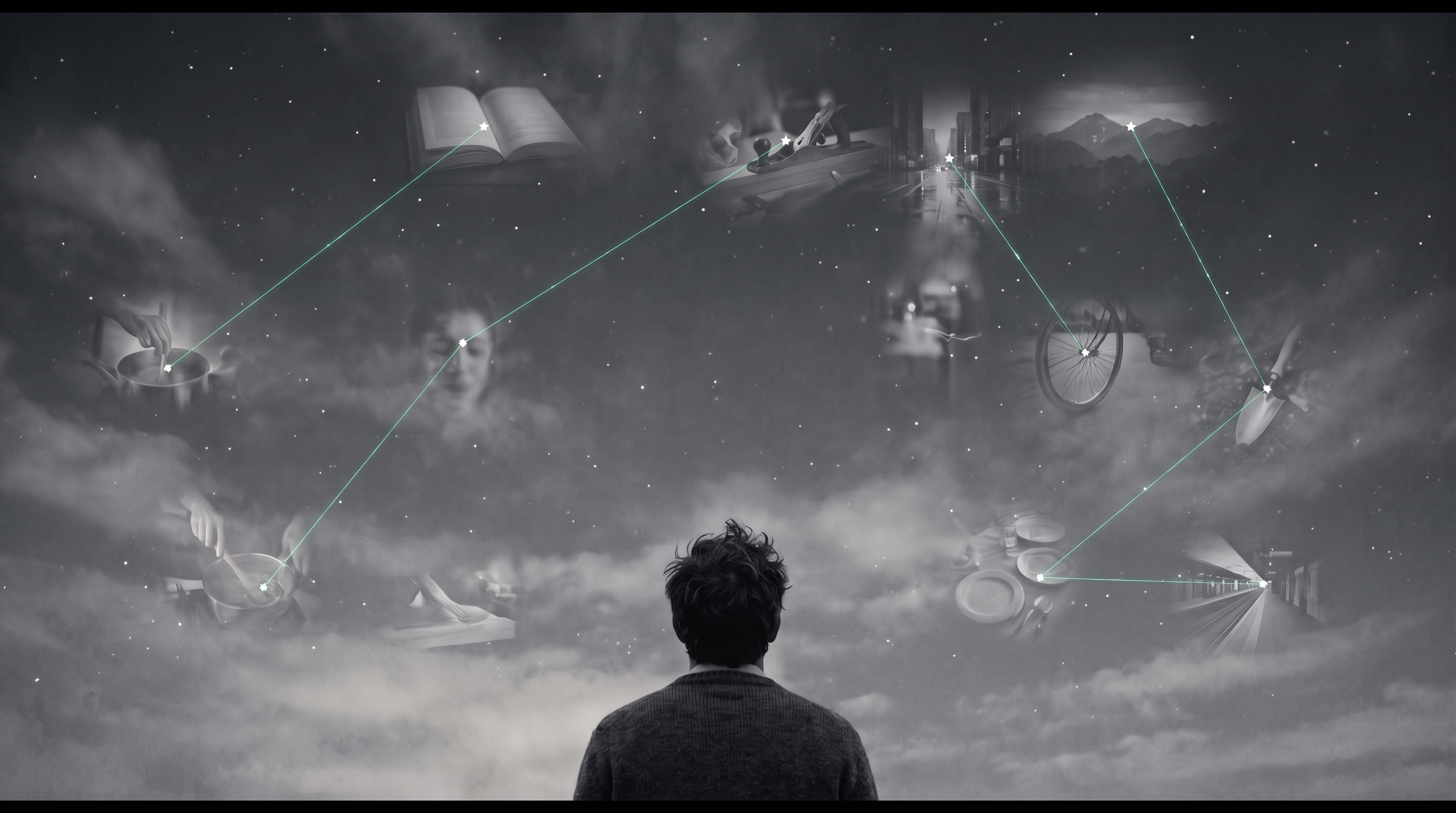
I was having a conversation on linkedin a while back. Someone had built a team of AI agents to help them write their posts, giving them personalities and a full workflow, interesting stuff that I said I’d borrow for inspiration. Their argument was that the machinery they’d built was what set them apart, what kept them ahead. And that’s what stuck with me.
However, soon anybody will be able to either build that machinery or just access it (like an OpenClaw level Muse agent, the one meta launched recently), so if not that hard-earned machinery, what is it that will keep you ahead?
There are dozens of tools for building second brains now. Most people now have access to a team of agents with good memory and good set of tools and skills. So the machinery that set you apart at the beginning is now commoditized.
So what sets you apart?
I think the thing that sets you apart is your lived experience.
What you’ve lived
That thing that’s unique to you and nobody else, where you come from, what you’ve seen, what you’ve lived, who you interact with, what content you consume. I’m not claiming that one is better than the other. I’m just saying that it differentiates each individual from the next.
I can give an agent access to my notes, the books I’ve read, the conversations I’ve recorded. That’s useful, I do it. But those notes came from somewhere. I chose to read that book, had that conversation with that person, paid attention to something because it connected to a situation I’d already lived.
That gives the agent access to what I’ve captured. My lived experience is where I got the material and why I thought it was worth capturing. Giving everyone access to memory doesn’t give everyone the same context to put into it.
So now that we have tools that allow us to speak an idea into existence, realizing those ideas is no longer hard, but coming up with them is.
I recently wrote about how our brain is able to come up with ideas and connect them, but I didn’t dig any deeper into what we’re feeding the brain that can then make the connections. That’s what this post is about, the source of the ideas it has available to connect.
Ideas at the intersection
I’ve always thought that this saying is true, that innovation lives on the edge, on the intersection. And I believe that. I think some of the best innovations or inventions come from individuals who were intersecting two fields, like biology and engineering, or electronics and medicine.
Wilson Greatbatch’s work on the implantable cardiac pacemaker brought electrical engineering into medicine. He trained as an electrical engineer and worked in medical electronics. The invention connected what he understood about circuits with a medical problem.
MRI came through a similar intersection. Paul Lauterbur was a chemist who developed magnetic-field gradient imaging, and Peter Mansfield was a physicist whose contributions included slice selection. They shared the 2003 Nobel Prize in Physiology or Medicine. Their work brought knowledge from chemistry and physics into a way of looking inside the body.
Frans Johansson describes this in The Medici Effect, where existing concepts from different fields, disciplines, and cultures combine into new ideas. Steven Johnson’s account of the adjacent possible describes how the parts within reach shape what we can make next, and how exploring those possibilities opens up more of them.
Sarnoff Mednick’s associative account of creativity connects creativity with bringing more remote elements together. That gives the distance between the fields a role in the mechanism, beyond just knowing more facts.
I think lived experience works the same way. A book, a conversation, a skill, a situation you’ve been in gives you something to connect. The combination available to you depends on which of those you’ve encountered and what you understand about them.
The average of the echo chamber
Our uniqueness lies in how we choose to expand our existence. Who do we meet? Who do we talk to? What are we curious about?
We get fed content from the algorithm through Instagram, TikTok, YouTube, and whatever social media you pick, and that’s designed to be an echo chamber because that mechanism has proven to be very efficient by the attention merchants.
If we’re all just consuming that, then at the end we’re just going to be the average of that echo chamber. Nothing will set us apart.
Allison Chaney, Brandon Stewart, and Barbara Engelhardt found in simulations of recommender systems that feedback loops homogenized user behavior without corresponding improvements in utility. The feed optimizes for engagement, and engaging content skews toward what everyone already likes, so we drift toward the same middle.
If the material keeps coming from the same narrow set of interests and people, the distant fields I believe ideas come from have fewer chances to meet. I can’t draw on an experience I’ve never had or a perspective I’ve never encountered.
The curious eclectics
So I believe that the future belongs to the curious eclectics, the ones who nurture different, opposite maybe, skills and different hobbies and interests. Their lived experience gives them material that reaches across fields, and making a useful connection between those fields is the work our brain thrives on.
I think, if we are able to become just a little bit more curious and willing to expand our areas of interest, the machinery we will be able to speak into existence through AI will constantly be ahead of the norm.