Recall
I know I wrote this down
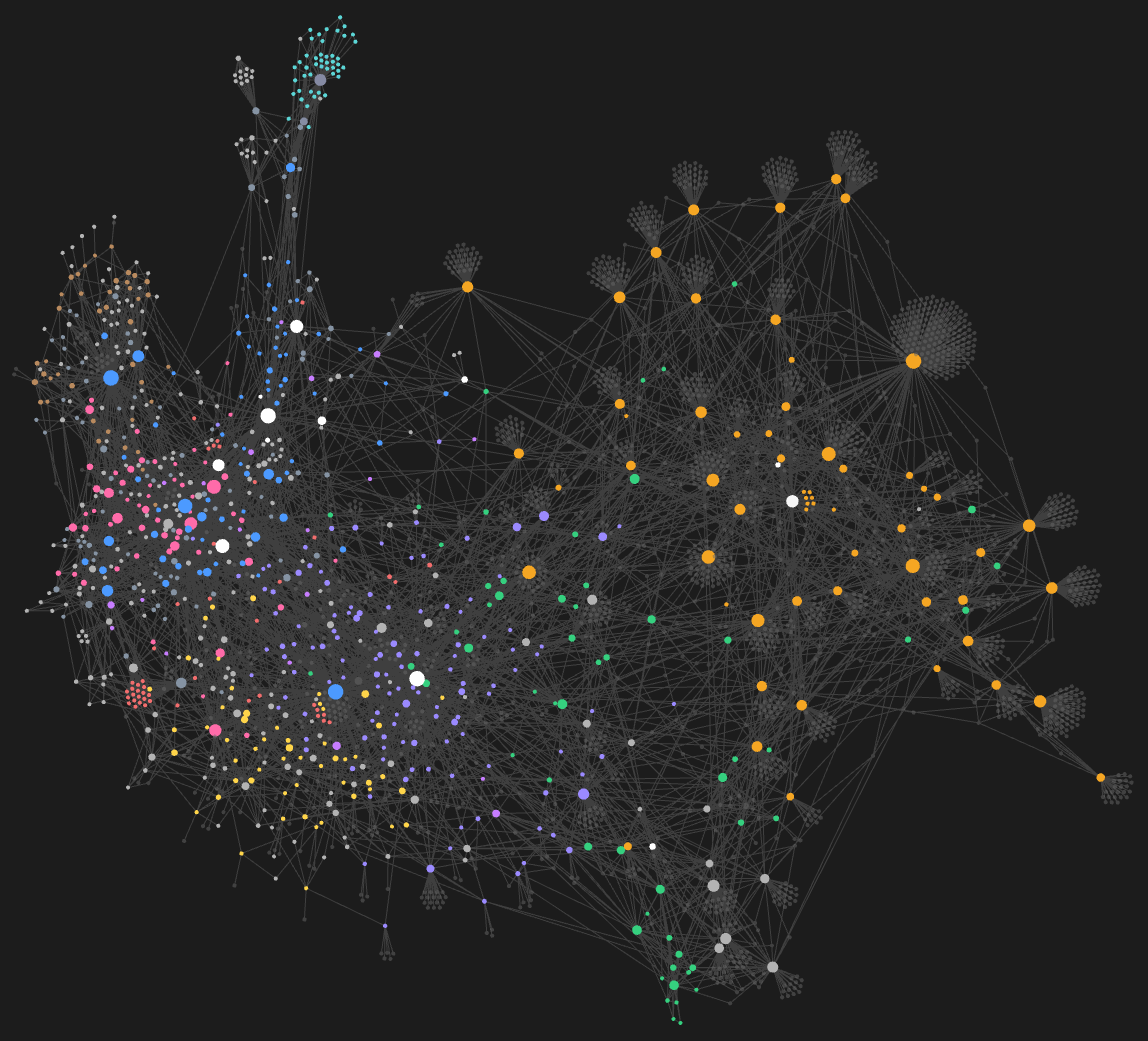
I’ve already done the work, thought through an idea, written the note, connected it to something else in my vault. Then, a few weeks later, when I sit down to write about something unrelated, that note never comes to mind. I wrote it in a different situation, about a different thing, so nothing in front of me now points back to it.
Sometimes I remember enough to search, a phrase or a topic that gives me somewhere to start looking. Sometimes I only have the feeling that I’ve been here before, and my memory won’t give me anything more specific.
That’s an interesting recall problem, getting material out of my vault’s knowledge graph when I need to think with it.
In What Sets You Apart, I wrote about the material I’ve accumulated through my own work, interests, and experiences. That post was about having the material. This one is about getting it back when I need it, which writing it down doesn’t guarantee.
Remembering needs something to work with
Directed recall is hard for the human brain, when I want a specific memory at a specific moment. My current task gives me some context, but it doesn’t necessarily give me the cues that bring that memory back.
John Kihlstrom’s account of memory retrieval describes the usual progression from free recall through cued recall to recognition. Producing an answer without help is generally harder than retrieving it with a cue or recognizing it when it’s presented.
Daniel Schacter calls the temporary inability to retrieve available information blocking, which produces the familiar tip-of-the-tongue experience. Remembering also involves reconstruction, with what we retrieve shaped by existing knowledge and the context we’re retrieving it in.
So making a decision to remember something is not sufficient, I need something that helps the relevant material in my mind become accessible.
Search gives me a starting point when I can describe what I’m missing, which I covered in Making Your Second Brain AI-Compatible (Part 1). But search starts with a question, and a good question needs to name exactly what I’m looking for.
Finding a connection I hadn’t asked for
A good example for this is the connection between taste and technical debt, which became Taste Debt.
I had accumulated notes about taste, and also notes about technical debt, without bringing those ideas together explicitly. As I described in The Capture Loop (Part 5), those bodies of work only met through index pages.
During clarification of a captured idea, the agent explored the existing material and surfaced the relationship between those notes. I hadn’t asked the agent to connect taste with technical debt, because I hadn’t recognized that connection myself yet.
Once the material came together, the relationship made sense, and I could work with it and give it a name.
Having an Obsidian graph mattered here, because it gave the agent a route through material beyond the immediate wording of my request. Notes I’d written around separate questions became relevant to each other, even though I hadn’t deliberately gone looking for that relationship.
Giving the agent a route through my notes
Tulving’s encoding specificity principle ties retrieval to the overlap between available cues and how an experience was encoded. A cue helps when it connects with the way the information was originally stored.
I use that as a design principle for my vault, preserving enough context and connections to give retrieval somewhere to go.
A note holds more than the conclusion I reached, it can hold the question, the example, and links to related reasoning. Those details give me additional ways to recognize why an old note belongs in something I’m working on now.
Obsidian’s wikilink format makes those relationships available for an agent to follow, and I’ve taught the agent to navigate through them. It can start with the current topic, read a related note, and follow a connection into material I had left out.
And I link liberally. I keep notes on almost everything, and when I write one I wikilink the concepts and the interesting parts of the text, even the ones I don’t have a note for yet. An unresolved link still does work: it marks the idea as somewhere the graph can reach, and it’s waiting there the day I finally write that note. Here’s a concept note of mine on technical debt, with those links in place:
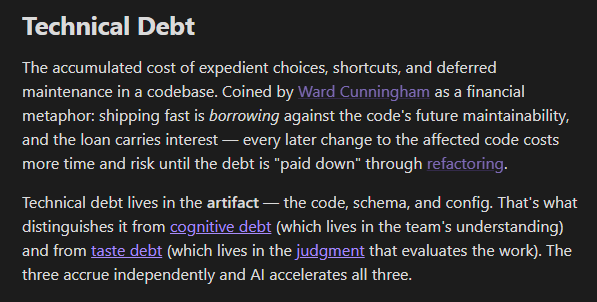
Each of those links is an anchor the agent can follow into material I wasn’t thinking about.
And this is how that note sits in the graph, connected to the other notes that reference it:
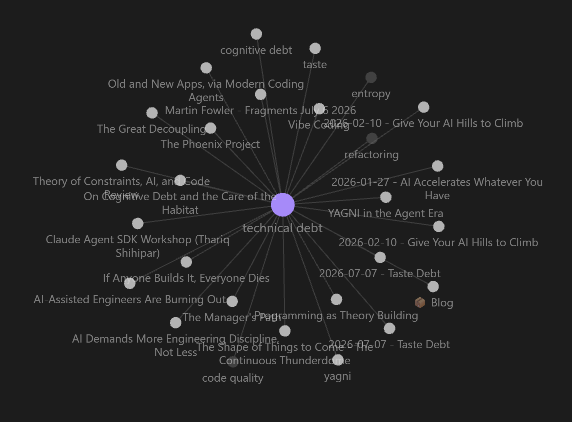
In Bandwidth I wrote about widening the channel between the agent and my environment. This applies that to the reasoning I’ve already captured.
The vault gives me a practical advantage over relying on recall alone, because the agent can inspect those recorded relationships on demand. I don’t need to produce every relevant idea from memory before the agent can begin helping me think through them.
Keeping the connecting work human
I want to take advantage of associative retrieval and the default mode network, and leave room for connections to occur spontaneously. In AI Will Never Have Shower Thoughts, I wrote about how those loose, unfocused moments are where my best connections tend to come from.
Neuroscientists have described decreases in default-mode activity during attention-demanding tasks and linked the network to spontaneous thought during mind-wandering. That gives me a strong reason to make room for associative thinking instead of just the directed work of looking something up, which is the shower-thoughts argument.
I can let the vault handle finding a passage while I stay with the idea I’m trying to develop. When it brings back related material, I can compare it with the current problem and decide whether the connection holds.
I’m also concerned about offloading the thinking I want to keep practicing, so I draw the boundary around what I delegate. Storing a note and retrieving it are useful jobs to hand over, evaluating its relevance remains part of my work, keeping judgement and taste as human tasks.